AI Agent vs RAG: Quick Answer
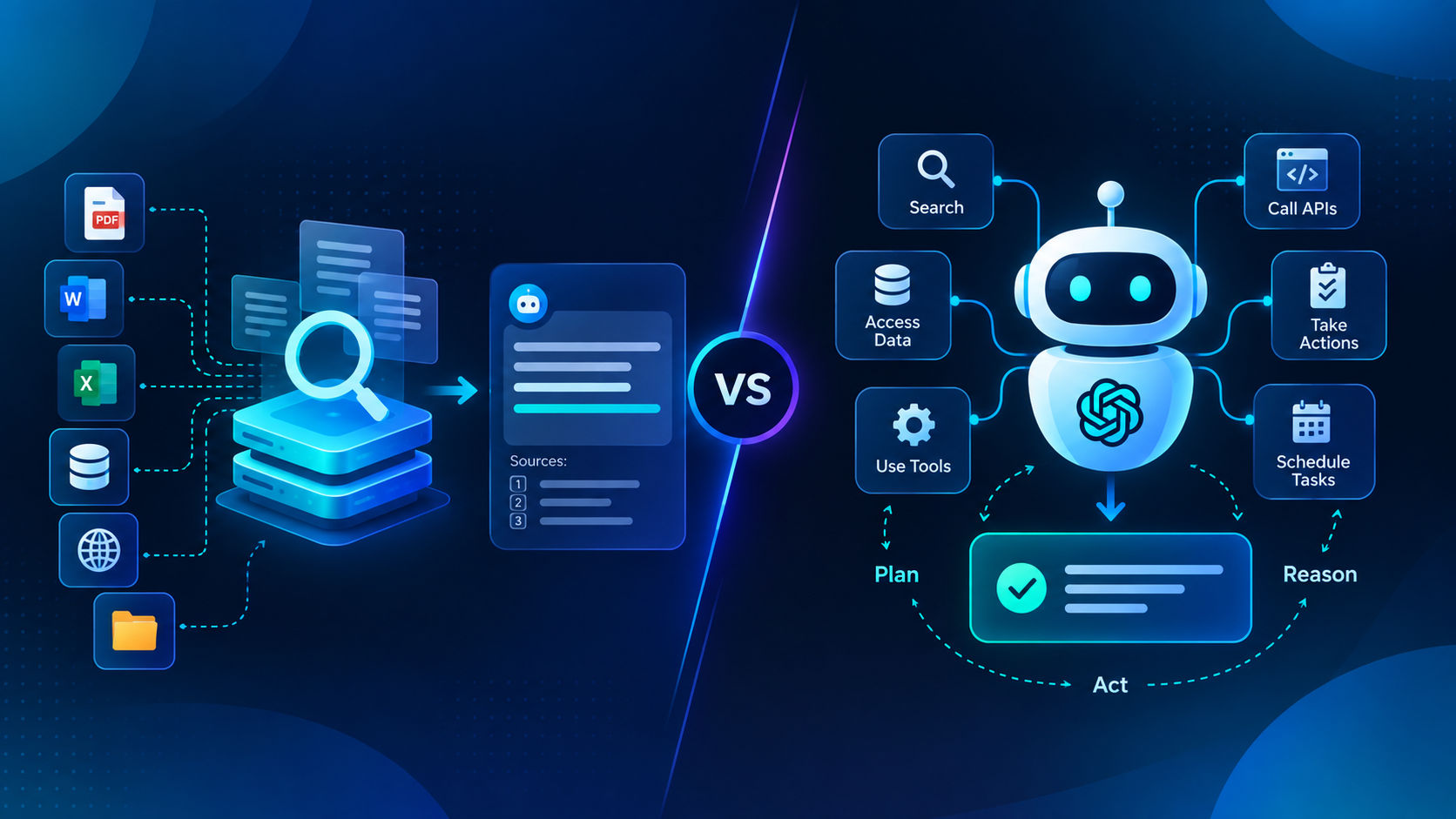
RAG and AI agents solve different problems. RAG helps an AI application retrieve relevant information from external or private data sources and provide that context to an LLM. An AI agent goes further by reasoning through a task, using tools, making decisions, and taking actions. For many business applications, AI agents and RAG work best together.
This distinction is becoming increasingly important as companies move from basic AI chatbots toward enterprise AI applications, intelligent automation, knowledge assistants, and autonomous workflows.
For businesses working with proprietary data, an AI agent with RAG can combine knowledge retrieval + reasoning + actions in a single application.
At DevBay Technologies, this combination is particularly relevant to AI-first product engineering, where RAG systems, LLM applications, AI agents, and business automation can be designed as part of a broader AI architecture.
RAG vs AI Agent: Key Differences
The simplest way to understand the difference is:
| Feature | RAG | AI Agent |
|---|---|---|
| Primary purpose | Retrieve relevant information | Complete tasks and workflows |
| External knowledge | Yes | Optional |
| Uses an LLM | Usually | Usually |
| Retrieves business data | Core capability | Optional, often through RAG |
| Uses tools/APIs | Sometimes | Common |
| Takes actions | Limited | Yes |
| Multi-step reasoning | Limited | Common |
| Workflow automation | Limited | Strong |
| Autonomy | Lower | Higher |
| Best for | Knowledge retrieval | Task execution and automation |
| Can work together? | Yes | Yes |
So, RAG is not necessarily an alternative to an AI agent.
In many modern enterprise systems, RAG becomes one component inside an AI agent.
What Is RAG?
Retrieval-Augmented Generation (RAG) is an AI architecture that allows an LLM to retrieve relevant information from an external knowledge source before generating a response.
Instead of relying only on information contained within the model, a RAG application can search:
- Company documents
- PDFs
- Databases
- Knowledge bases
- Websites
- Product catalogs
- CRM data
- Internal documentation
- APIs
A simplified RAG workflow looks like:
For example, imagine an employee asks:
A RAG application can search the company's HR documents, retrieve the relevant policy, provide it to the LLM, and generate an answer based on the retrieved content.
What is RAG best for?
RAG is particularly useful when an application needs to answer questions using private, domain-specific, or frequently changing information.
Common examples include:
- Enterprise knowledge assistants
- Customer-support chatbots
- Document search
- Legal document assistants
- Internal company search
- Product support
- Research assistants
- Financial knowledge systems
What Is an AI Agent?
An AI agent is an AI-powered system designed to accomplish a goal by reasoning through tasks, selecting actions, using tools, and responding to changing conditions.
Unlike a basic chatbot, an AI agent may interact with external systems.
For example, a customer could ask:
An AI agent could potentially:
- Understand the request
- Access the order-management system
- Retrieve customer records
- Check shipping information
- Identify the delayed order
- Call another API
- Generate a response
- Trigger an approved action
This is where AI agents become particularly valuable for business process automation.
AI Agent vs RAG: How They Actually Work
A RAG application typically focuses on retrieving the right information.
An AI agent focuses on deciding what needs to happen next.
Consider a sales organization.
RAG application
A salesperson asks:
The system retrieves the relevant product information and generates an answer.
AI agent
A salesperson asks:
The agent may:
- Access the CRM
- Filter leads
- Analyze lead information
- Prioritize prospects
- Retrieve relevant product information
- Draft personalized emails
- Request approval before sending
AI agent + RAG
Now imagine the agent also needs access to:
- Product documentation
- Pricing information
- Sales playbooks
- Case studies
- Customer policies
The agent can use RAG to retrieve this information before deciding what to do.
This is where the combination becomes powerful.
Can an AI Agent Use RAG?
Yes. An AI agent can use RAG as one of its tools or capabilities.
The agent can retrieve information from a company's knowledge base, use that information in its reasoning process, and then perform an action through an API or another business tool.
A simplified architecture could look like:
For example:
This architecture can support more sophisticated enterprise applications than a standalone RAG chatbot.
AI Agent + RAG Architecture
A production AI agent with RAG can contain several components.
1. User Interface
The user interacts through:
- Web application
- Mobile application
- Chat interface
- Microsoft Teams
- Slack
- Voice interface
2. Agent Orchestration
The orchestration layer determines:
- What the user wants
- Which tools are required
- What information should be retrieved
- What action should happen next
3. RAG Layer
The RAG system retrieves relevant information from:
- Documents
- Databases
- APIs
- Knowledge bases
- Enterprise applications
4. LLM
The language model interprets the context and helps determine the next step.
5. Tools
An agent can potentially use tools such as:
- CRM APIs
- ERP systems
- Search
- Databases
- Calendar
- Payment systems
- Internal applications
6. Security Layer
Enterprise implementations may require:
- Authentication
- Authorization
- Role-based access
- Data isolation
- Audit logging
- Encryption
- Approval workflows
7. Evaluation & Monitoring
The system should be monitored for:
- Incorrect retrieval
- Unsupported answers
- Tool failures
- Latency
- Cost
- Security issues
- Task completion
Not Sure Whether You Need RAG or an AI Agent?
Before development starts, evaluate your business workflow, data sources, integrations, security requirements, and desired level of automation. The right architecture can help avoid unnecessary complexity and development costs.
Discuss Your AI ArchitectureWhen Should a Business Use RAG?
RAG is generally a good fit when your primary requirement is accessing and answering questions using business knowledge.
Consider RAG when:
- Your information changes frequently
- Your business has large document collections
- Employees need internal knowledge access
- Customers need answers from product documentation
- Your AI needs private company information
- Answers should reference business sources
- You want a knowledge assistant
- You need document-based AI
Example
A manufacturing company could build a RAG assistant that answers questions about:
- Equipment manuals
- Maintenance procedures
- Safety documentation
- Product specifications
- Internal policies
The assistant does not necessarily need to take action. Its primary job is finding and explaining relevant information.
When Should a Business Build an AI Agent?
An AI agent becomes more useful when the application needs to perform tasks rather than simply answer questions.
Consider an AI agent when your workflow involves:
- Multiple steps
- Business rules
- External systems
- APIs
- Decision-making
- Workflow automation
- Repetitive manual tasks
- Human approval processes
Example
A customer-support agent could:
- Understand a customer's problem
- Retrieve account information
- Search company policies using RAG
- Check the order system
- Determine whether the request qualifies for a refund
- Create a support ticket
- Escalate complex cases
- Notify the customer
That is more than retrieval.
It is task execution.
When Should You Use AI Agent + RAG?
For many enterprise applications, the most useful architecture may be AI agent + RAG.
Customer Support
RAG: Retrieves policies and product information.
Agent: Checks customer records, creates tickets, and escalates issues.
Sales
RAG: Retrieves product information, pricing policies, and case studies.
Agent: Analyzes leads, updates CRM records, and prepares follow-ups.
HR
RAG: Retrieves company policies.
Agent: Helps employees complete HR workflows and submit requests.
IT Support
RAG: Retrieves technical documentation.
Agent: Diagnoses issues, checks systems, and creates tickets.
Finance
RAG: Retrieves financial policies and documentation.
Agent: Performs approved workflow actions and generates reports.
RAG vs AI Agents: Which Is Better?
There is no universal winner.
The right choice depends on your business objective.
| Business Requirement | Recommended Approach |
|---|---|
| Search company documents | RAG |
| Answer knowledge questions | RAG |
| Internal knowledge assistant | RAG |
| Customer-support knowledge base | RAG |
| Automate repetitive workflows | AI Agent |
| Interact with APIs | AI Agent |
| Multi-step business process | AI Agent |
| Make decisions within defined workflows | AI Agent |
| Business knowledge + actions | AI Agent + RAG |
| Enterprise AI automation | AI Agent + RAG |
Simple rule
If your question is:
Start by evaluating RAG.
If your question is:
Evaluate an AI agent.
If you need both:
Consider AI Agent + RAG.
RAG vs AI Agent: Development Complexity
RAG and AI agent development also differ in complexity.
Basic RAG application
- Data ingestion
- Chunking
- Embeddings
- Vector database
- Retrieval
- LLM
- User interface
AI agent
- Agent orchestration
- Tool calling
- Workflow management
- Memory
- APIs
- Business rules
- Error handling
- Human approval
- Monitoring
- Security
An AI agent with RAG combines both architectures and can therefore require substantially more engineering.
The important point is not to choose the most complex architecture simply because it is more advanced.
Choose the architecture that solves the business problem.
How Much Does AI Agent + RAG Development Cost?
The cost depends on the complexity of the application rather than simply whether RAG or an agent is being used.
Major cost factors include:
- Number of data sources
- Document volume
- RAG architecture
- LLM selection
- Vector database
- Number of tools
- API integrations
- Workflow complexity
- Security requirements
- User volume
- Evaluation
- Monitoring
- Cloud infrastructure
- Ongoing model usage
A simple internal knowledge assistant may require a relatively straightforward architecture.
An enterprise AI agent connected to CRM, ERP, databases, documents, APIs, and multiple business workflows requires considerably more engineering.
For this reason, businesses should define the minimum viable workflow before estimating the total development budget.
How to Choose an AI Agent or RAG Development Company
If you are evaluating an AI agent development company or RAG development company, don't evaluate vendors only by their ability to create a chatbot.
RAG expertise
- How do you handle document ingestion?
- How do you select chunk sizes?
- Which embedding models do you use?
- Which vector databases have you implemented?
- How do you evaluate retrieval quality?
- How do you handle reranking?
AI agent expertise
- How are tools selected?
- How are multi-step workflows orchestrated?
- How are failed tool calls handled?
- How are permissions managed?
- When is human approval required?
- How do you evaluate agent performance?
Enterprise readiness
Also ask about:
- Security
- Authentication
- Authorization
- Data privacy
- Monitoring
- Cost optimization
- Scalability
- Deployment
- Maintenance
A strong partner should be able to explain why a particular architecture is appropriate for your business, rather than simply recommending the newest AI technology.
Why Consider DevBay Technologies?
DevBay Technologies focuses on AI-first product engineering, including RAG systems, AI agents, LLM applications, AI automation, and AI architecture.
For businesses evaluating an AI agent or RAG project, DevBay can help determine whether the use case requires:
- RAG
- AI agents
- AI Agent + RAG
- LLM application development
- AI automation
- Broader AI-first product engineering
This distinction matters because not every business problem requires an autonomous AI agent.
Sometimes a well-designed RAG application is enough.
In other cases, an agent that can retrieve information and execute workflows can provide significantly more value.
DevBay also offers AI architecture assessment capabilities for businesses that want to evaluate their existing systems and identify opportunities for AI integration before beginning a larger implementation.
Ready to Build Your AI Agent or RAG Solution?
Whether you need a RAG knowledge system, AI agent, enterprise LLM application, or AI-powered automation workflow, the right architecture should start with your business requirements.
Explore AI Development Talk to DevBayAI Agent vs RAG: Frequently Asked Questions
Is RAG an AI agent?
No. RAG is an architecture for retrieving relevant external information and providing it to an LLM. An AI agent is designed to perform tasks, use tools, make decisions, and execute workflows. An AI agent can use RAG as one of its capabilities.
Can an AI agent use RAG?
Yes. An AI agent can use RAG to retrieve information from company documents, databases, knowledge bases, or other sources before deciding what action to take.
What is the difference between RAG and AI agents?
RAG primarily focuses on information retrieval and grounded generation, while AI agents focus on task execution, reasoning, tool use, and workflow automation. They can also be combined to create AI systems that retrieve business knowledge and perform actions.
Is RAG better than AI agents?
Neither is universally better. RAG is generally more appropriate for knowledge retrieval and question answering, while AI agents are more appropriate for multi-step tasks and workflow automation. Businesses that need both knowledge and actions may benefit from combining RAG with AI agents.
What is an agentic RAG system?
An agentic RAG system combines retrieval with agent-based decision-making. Instead of retrieving information once and generating an answer, the system can determine what information it needs, retrieve it, use tools, and continue through multiple steps to complete a task.
Can RAG and AI agents work together?
Yes. RAG can provide an AI agent with access to proprietary or frequently changing information. The agent can then use that information along with tools and business workflows to complete tasks.
Should my business build RAG or an AI agent?
Start with the business outcome. If you mainly need AI to search and answer questions from business information, RAG may be sufficient. If you need AI to execute multi-step workflows or interact with business systems, an AI agent may be more appropriate.
Conclusion
The AI agent vs RAG debate is not really about choosing one technology over another.
They address different layers of an AI application.
And when businesses need both, AI Agent + RAG can provide a powerful architecture for enterprise AI applications.
Before starting development, define what your AI application actually needs to accomplish. Determine whether it needs to retrieve information, make decisions, use tools, interact with business systems, or complete multi-step workflows.
Then select the simplest architecture that can reliably achieve that goal.
For companies planning RAG development, AI agent development, or AI-powered automation, a technical architecture assessment can help identify the right approach before development begins.
Ready to Explore Your AI Use Case?
Let's evaluate your business requirements, data, workflows, integrations, and AI architecture to determine the right approach for your project.
Hire AI Developers Talk to DevBayAuthor & E-E-A-T Information
Author: DevBay Editorial Team
Technical Reviewer: DevBay AI Engineering Team
Publisher: DevBay Technologies
Published: September 2026
Last Updated: September 2026
About the Author
The DevBay Editorial Team publishes practical resources covering AI development, RAG, AI agents, LLM applications, AI automation, software engineering, cloud technologies, and enterprise AI.