Enterprise RAG: Quick Answer
Enterprise RAG is a retrieval-augmented AI architecture designed to securely retrieve an organization's private or domain-specific information and provide it as context to an LLM.
Unlike a basic chatbot, enterprise RAG can connect AI applications with internal documents, databases, knowledge bases, product information, CRM data, support documentation, and other business systems.
A production-ready implementation also needs to consider security, access control, retrieval quality, scalability, evaluation, monitoring, integrations, and ongoing maintenance.
What Is Enterprise RAG?
Enterprise RAG is a retrieval-augmented AI system designed to securely retrieve and use an organization's private or domain-specific information when generating AI responses.
Unlike a basic chatbot that primarily relies on an LLM's existing knowledge, an enterprise RAG application can retrieve relevant information from business-controlled sources.
These may include:
- Internal documents
- PDFs
- Product catalogs
- Knowledge bases
- CRM systems
- Databases
- Support documentation
- HR policies
- Legal documents
- Technical manuals
- Websites
- APIs
- Enterprise applications
The retrieved information is then provided as context to an LLM, which generates a response based on that context.
Enterprise RAG vs Basic RAG
A simple RAG prototype can often be built around a document collection and a vector database.
Enterprise RAG usually requires considerably more engineering.
| Capability | Basic RAG | Enterprise RAG |
|---|---|---|
| Document retrieval | Yes | Yes |
| Vector database | Usually | Usually |
| Multiple data sources | Limited | Common |
| Hybrid search | Optional | Often valuable |
| Reranking | Optional | Often required |
| Authentication | Basic | Enterprise-grade |
| Role-based access | Limited | Important |
| Data permissions | Basic | Granular |
| API integrations | Limited | Common |
| Monitoring | Basic | Required |
| Evaluation | Basic | Continuous |
| Scalability | Limited | High |
| Audit logging | Optional | Often required |
The key difference is that enterprise RAG must operate reliably within an organization's existing technology, security, and data environment.
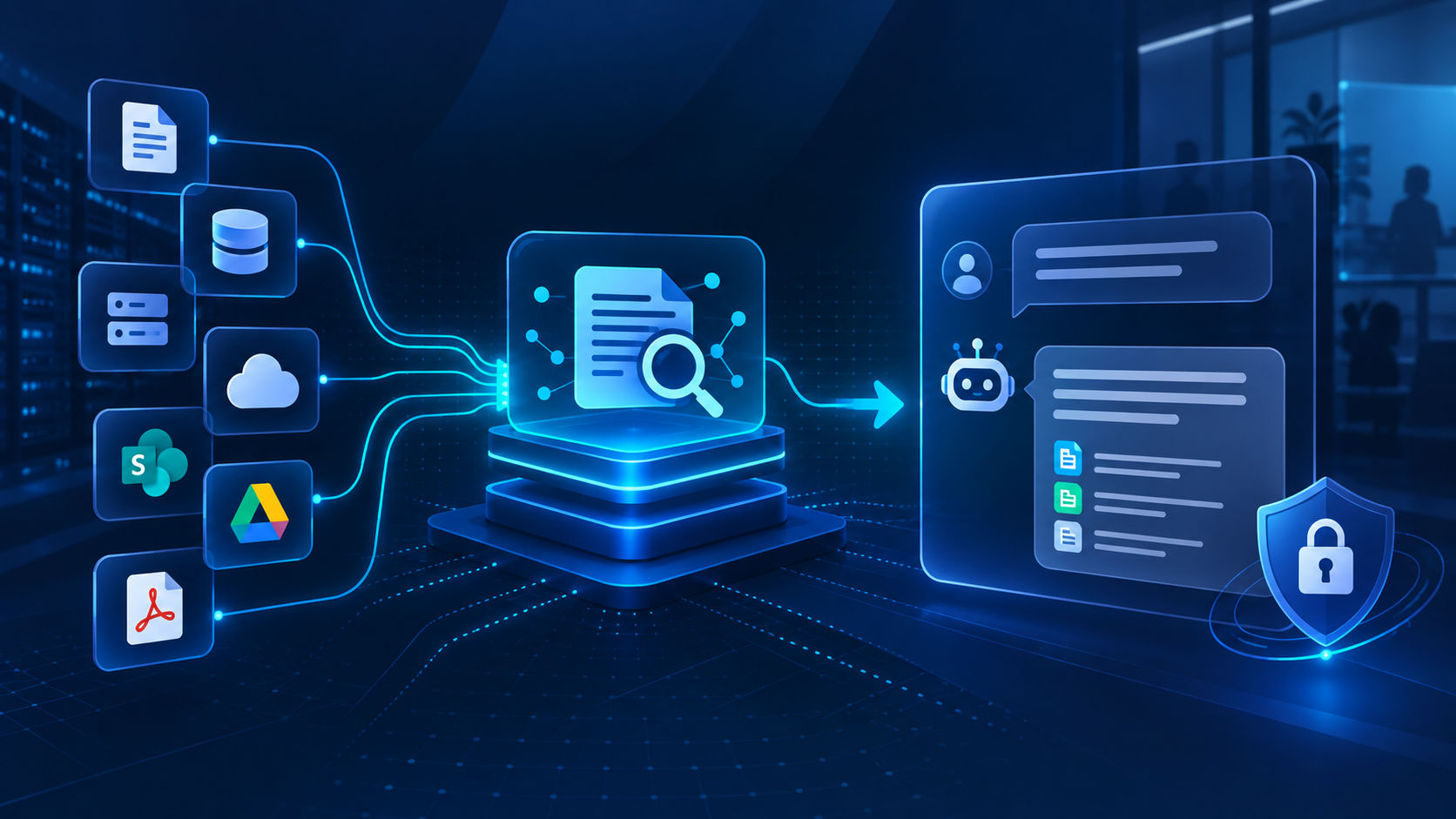
Enterprise RAG Architecture
A production enterprise RAG solution typically contains several layers.
1. Data Sources
The first layer contains the information the AI application needs to access.
- SharePoint
- Google Drive
- CRM systems
- ERP systems
- SQL databases
- PDFs
- Word documents
- Product catalogs
- Internal websites
- APIs
2. Data Ingestion
The ingestion layer collects information from different sources and prepares it for retrieval.
Typical activities include:
- Document extraction
- Data cleaning
- Format normalization
- Metadata extraction
- Duplicate detection
- Version management
- Data synchronization
3. Chunking and Document Processing
Large documents are usually divided into smaller sections called chunks.
The chunking strategy should preserve enough context to make each retrieved section meaningful.
Depending on the content, an enterprise RAG implementation may need to account for:
- Document structure
- Headings
- Tables
- Sections
- Page numbers
- Metadata
- Document versions
- Relationships between sections
4. Embeddings
Embeddings convert text into numerical representations that allow semantically similar information to be identified.
For example, a user might search:
while the source document contains:
Semantic retrieval can identify that these concepts are related even though the wording is different.
5. Vector Database and Search
The system stores embeddings and associated metadata in a retrieval system.
Depending on requirements, enterprise RAG architectures may use vector search, keyword search, or hybrid search.
Hybrid retrieval can combine semantic similarity with traditional keyword matching.
6. Reranking
Initial retrieval may return several potentially relevant results.
A reranking layer can evaluate those results and prioritize the most relevant passages before they are sent to the LLM.
7. LLM Layer
The LLM receives the user's question together with retrieved context.
The application can instruct the model to answer using retrieved information, avoid unsupported claims, cite sources where appropriate, and state when information is unavailable.
8. Application and API Layer
Enterprise RAG applications often need to connect with existing business systems such as CRM, ERP, helpdesk, HR platforms, data warehouses, and internal APIs.
This is also where RAG can become part of a larger AI agent architecture.
If you are deciding between these architectures, read our AI Agent vs RAG guide .
Enterprise RAG Security: What Should Businesses Consider?
Security is one of the most important differences between a prototype and an enterprise AI system.
An enterprise RAG application may have access to confidential information, so retrieval should not automatically mean that every user can access every document.
Authentication
Users should be properly authenticated before accessing protected enterprise information.
Authorization
The system should determine what information a user is permitted to access.
Role-Based Access
Different users may require different levels of access.
- HR employees → HR documentation
- Finance employees → Financial information
- Sales employees → Sales resources
- Customers → Public or customer-specific information
Metadata-Based Filtering
Retrieval can incorporate metadata such as department, user role, region, document type, customer, and access level.
Data Encryption
Sensitive data should be protected during transmission and storage according to the organization's security requirements.
Audit Logging
Organizations may need to record who accessed information, what was retrieved, which system was used, what actions occurred, and when the activity happened.
Human Approval
For sensitive workflows, the AI system may need human approval before taking an action.
Is Your Architecture Ready for Enterprise RAG?
Evaluate your data sources, retrieval architecture, integrations, security requirements, and AI readiness before investing in a larger RAG implementation.
Explore AI Architecture AuditEnterprise RAG Use Cases
1. Internal Knowledge Assistant
Employees can ask questions about company policies, procedures, documentation, and internal resources.
2. Customer Support
A RAG-powered support assistant can retrieve information from product documentation, FAQs, troubleshooting guides, support policies, and knowledge bases.
3. Legal Document Intelligence
Legal teams can use RAG to search and analyze large collections of contracts, agreements, policies, regulatory documents, and legal correspondence.
4. Product Knowledge
Companies with large product catalogs can use RAG to answer questions about product specifications, compatibility, features, documentation, installation, and pricing policies.
5. HR Knowledge Systems
Enterprise RAG can help employees find information about benefits, leave policies, employee handbooks, workplace procedures, and internal policies.
6. Technical Support
Engineering and IT teams can use RAG to search technical documentation, system manuals, troubleshooting guides, internal runbooks, and knowledge bases.
7. Research and Intelligence
RAG can help researchers retrieve relevant information from large collections of documents and generate summaries based on retrieved sources.
How to Build an Enterprise RAG System
Step 1: Define the Use Case
Start by identifying the business problem, users, information requirements, and expected AI capabilities.
Step 2: Audit Your Data
Evaluate data sources, quality, formats, freshness, duplicates, permissions, and ownership.
Step 3: Design the Retrieval Architecture
Determine vector search, keyword search, hybrid retrieval, embeddings, chunking, metadata, reranking, and filtering requirements.
Step 4: Select the LLM and Infrastructure
Evaluate quality, latency, cost, data requirements, security, scalability, and vendor dependencies.
Step 5: Implement Security
Define access controls before connecting sensitive business data.
Step 6: Build an MVP
Start with a focused use case rather than connecting every enterprise system at once.
Step 7: Evaluate Retrieval Quality
Measure retrieval relevance, answer correctness, groundedness, citation accuracy, latency, and failure rates.
Step 8: Integrate Business Systems
After retrieval quality is validated, connect the RAG system with relevant enterprise applications.
Step 9: Monitor and Improve
Track retrieval failures, incorrect answers, user feedback, latency, infrastructure costs, model usage, data freshness, and security events.
How Much Does Enterprise RAG Development Cost in 2026?
There is no single fixed price for enterprise RAG development.
The total cost depends on the architecture and scope of the project.
| Project Type | Typical Complexity |
|---|---|
| Internal document assistant | Low to moderate |
| Customer-support RAG | Moderate |
| Multi-source enterprise RAG | Moderate to high |
| Secure enterprise knowledge platform | High |
| Enterprise RAG + AI agent | High |
| Multi-system autonomous AI platform | Very high |
Major cost factors include:
- Number of data sources
- Document volume
- Data processing requirements
- Vector infrastructure
- LLM usage
- Search architecture
- Reranking
- API integrations
- Security
- User volume
- Monitoring
- Evaluation
- Cloud infrastructure
- Ongoing maintenance
Build vs Buy vs Outsource Enterprise RAG
| Approach | Advantages | Challenges |
|---|---|---|
| Build internally | Maximum control | Requires specialized AI engineering skills |
| Buy an existing platform | Faster initial deployment | May have customization limitations |
| Outsource development | Access to specialized expertise | Requires careful vendor selection |
| Hybrid approach | Combines internal ownership with external expertise | Requires strong coordination |
Common Enterprise RAG Mistakes
1. Connecting Every Data Source Immediately
More data does not automatically produce better answers. Start with the most valuable and reliable sources.
2. Ignoring Permissions
An AI system should not expose information simply because it exists in the connected knowledge base.
3. Focusing Only on the LLM
Changing the model may not solve a retrieval problem. RAG quality depends on the complete pipeline.
4. Skipping Evaluation
A system that works during a demo may still fail in production. Create evaluation datasets and test realistic questions.
5. Poor Document Processing
If documents are badly extracted, structured, chunked, or indexed, retrieval quality will suffer.
6. No Monitoring
Production AI applications need visibility into performance, errors, cost, and user feedback.
7. Making the Architecture More Complex Than Necessary
Not every enterprise use case needs an autonomous AI agent. Sometimes a well-designed RAG application is enough.
How to Choose an Enterprise RAG Development Company
When evaluating an enterprise RAG development company, look beyond whether the vendor can build a chatbot.
- How do you handle enterprise data ingestion?
- How do you design chunking strategies?
- Which retrieval methods do you use?
- When do you recommend hybrid search?
- How do you handle reranking?
- How do you implement document-level permissions?
- How do you evaluate retrieval quality?
- How do you monitor production RAG systems?
- How do you integrate RAG with existing APIs?
- How do you approach security and scalability?
A strong RAG development partner should be able to explain the reasoning behind the architecture—not simply recommend a vector database and LLM.
When Should You Consider an AI Architecture Audit?
Before investing heavily in enterprise RAG development, it can be useful to evaluate whether your existing technology environment is ready.
An AI architecture audit can examine:
- Data architecture
- Databases
- Data pipelines
- Vector stores
- APIs
- Application architecture
- Cloud infrastructure
- Security
- AI readiness
- RAG opportunities
- Performance bottlenecks
- Integration requirements
For organizations with an existing software platform, this can help identify where RAG or other AI capabilities can realistically fit into the current architecture.
Learn more about DevBay's AI Architecture Audit .
Why Work With DevBay for Enterprise RAG Development?
DevBay Technologies focuses on AI-first product engineering, including RAG systems, AI agents, LLM applications, AI automation, and broader AI product development.
For organizations evaluating an enterprise RAG project, the development process can involve:
- Use-case assessment
- RAG architecture
- Data pipeline design
- Knowledge-base integration
- Retrieval implementation
- LLM integration
- AI agent integration where required
- API integrations
- Security considerations
- Evaluation
- Production engineering
For projects that require both business knowledge and automated actions, RAG can become part of a broader AI agent architecture.
Explore DevBay's AI development services to discuss your requirements.
Enterprise RAG Implementation Roadmap
This approach helps organizations validate the core retrieval system before introducing unnecessary complexity.
Ready to Build an Enterprise RAG Solution?
Whether you need an internal knowledge assistant, customer-support RAG system, enterprise knowledge platform, or RAG-powered AI agent, the right architecture should start with your data and business requirements.
Hire AI Developers Talk to DevBayEnterprise RAG Frequently Asked Questions
What is enterprise RAG?
Enterprise RAG is a retrieval-augmented AI architecture designed to securely retrieve information from an organization's private or domain-specific data sources and provide that information as context to an LLM.
How is enterprise RAG different from regular RAG?
Enterprise RAG typically requires additional capabilities such as security, access control, multiple data integrations, scalability, monitoring, evaluation, audit logging, and enterprise data governance.
How much does enterprise RAG development cost?
There is no universal price. Cost depends on data sources, document volume, retrieval architecture, LLM usage, integrations, security requirements, user volume, monitoring, and ongoing infrastructure.
Is RAG secure for enterprise data?
RAG can be designed for enterprise environments, but security depends on the implementation. Authentication, authorization, access controls, data isolation, encryption, monitoring, and appropriate governance should be considered.
Can enterprise RAG work with an AI agent?
Yes. RAG can provide an AI agent with access to private business knowledge. The agent can then use retrieved information to reason through workflows and interact with approved business tools.
What industries can use enterprise RAG?
Enterprise RAG can support use cases across industries including technology, healthcare, finance, manufacturing, retail, legal services, education, customer support, and professional services, depending on data and security requirements.
Should we build RAG internally or hire a development company?
It depends on your internal AI engineering capabilities, security requirements, timeline, and long-term ownership strategy. Organizations without specialized RAG expertise may benefit from working with an experienced development partner.
Conclusion
Enterprise RAG development is not simply about connecting documents to an LLM.
A production-ready enterprise RAG system requires a combination of:
The right implementation starts with the business problem and data environment.
For a simple knowledge assistant, a focused RAG architecture may be sufficient. For more complex workflows, RAG can become part of an AI agent that retrieves business knowledge and takes approved actions.
The most important step is to design the architecture around your actual business requirements rather than choosing technology first.
Author & E-E-A-T Information
Author: DevBay Editorial Team
Technical Reviewer: DevBay AI Engineering Team
Publisher: DevBay Technologies
Published: September 2026
Last Updated: September 2026
About the Author
The DevBay Editorial Team publishes practical resources covering AI development, RAG, AI agents, LLM applications, AI automation, software engineering, cloud technologies, and enterprise AI.